|

Early Years in Dru-gu, Tibet:
While still in his mother's womb Choegyal Rinpoche was
recognized by H.H.16th Gyalwa Karmapa as Choegyal Yonten Gyamtso,
the present and 8th Dru-gu Choegyal incarnation in the Drukpa
Kagyu lineage. Choegyal Rinpoche took refuge with the Most Venerable
Sonam Tenzin and Kathog Getse and was enthroned at the age of
four. He spent the subsequent years of his childhood in the Dru-gu region of
Tibet, where, he says, "art, spiritual training and meditation
practice were inseparable."
Choegyal
Rinpoche began his training at the age of five.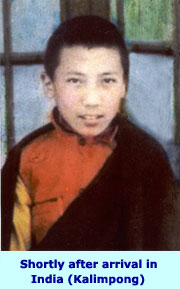
He memorized many religious texts and studied the 9 yanas. He
was trained from 1955 to1979 by H.H. 8th Khamtrul Rinpoche (an
accomplished artist as well as meditation master) and received
teachings and continual personal guidance from H.H. Dilgo Khyentse
Rinpoche. He became the lineage holder of a number of unique teachings.
Other root teachers were H.H.16th Gyalwa Karmapa, H.E. Tsentul
Logan Sotan Rinpoche, H.E. the 8th Dorzong Rinpoche, H.E. Adi
Rinpoche, Tokden Choelek, Tokden Ajam, and Most Venerable Sakya
Khenpo Rinchen. Rinpoche also received important teachings from
Nubgon Khen Lekshe, Zigar Khen Choedar, Dru-gu Gegan Dechen, Khenpo
Gedun of Kathog, Khenpo Tsondue, Khenpo Thubchoe, Sogchen Khenpo
Tsega, Nangchen Yangwen Khen Chen, and Khenpo Tipa of Chakzam
Gelugpa Monastery.
 Life
in India: Life
in India:
In
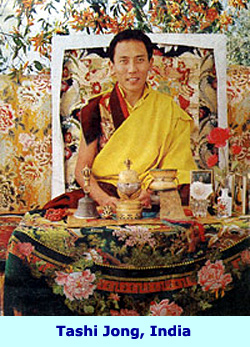
1959, Choegyal Rinpoche took asylum in India, joining his root
guru, the 8th Khamtrul Rinpoche, and a group of highly realized disciples
and Tokdens (a special group of tantric yogis). An increasing
number of monks and lay followers from Eastern Tibet gathered around
Khamtrul Rinpoche, forming a refugee community in Kalimpong. Later,
the community moved to the Kangra Valley in the high country of
Himachal Pradesh, first to Dalhousie, then to their present location
at Tashi Jong. Here, under the snow-capped Dhauladhar Range of
the Himalayas, Khamtrul Rinpoche acquired land for his followers
to rebuild their lives and to continue the rich heritage they brought from Tibet. Choegyal Rinpoche served the Tashi Jong
community from 1988 to 1994, first as vice-president, then as
president.
Recent
Years and Activities:
Like
most of his previous incarnations, Choegyal Rinpoche is a highly
gifted
and well known artist. His paintings, which have been widely exhibited, are remarkable for their vibrant immediacy of expression. They display a mastery over a broad range of styles, from the ornate precision of the traditional thankas to impressionistic evocations of meditative experiences.
His creative work also includes sculpture and carpet designs.
Rinpoche founded Dru-gu Unique Tiger and Snow Leopard Carpets
in cooperation with a Tibetan artisan community of carpet weavers
near Tara Bhir. His high quality limited edition carpets can now
be found in museums and private collections. Please See Art
Page for more information.
Since
1994 Rinpoche has directed his efforts towards the restoration
of the traditional art and culture as well as the improvement
of social welfare and environmental integrity of the Dru-gu
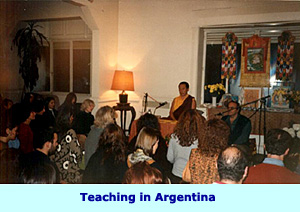
region of Tibet. Rinpoche has travelled extensively throughout
the world to teach the Dharma, exhibit his art and promote his
projects. Rinpoche divides his time between Tashi Jong,
the Jangchub Jong Buddhist Institute of H.E. Dorzong Rinpoche, and
the
Tara Bhir Dru-gu Retreat Center.
Each
of these places is special in its own way: Tashi Jong is now the
seat of H.H. 9th Khamtrul Rinpoche, the reincarnation of his root
guru, towards whom he has unshakable devotion and gratitude; Jangchub
Jong Buddhist Institute is the seat of H.E. Dorzong Rinpoche,
one of his most highly respected Dharma brothers and his most
revered living Drukpa Kagyu teacher; and Tara Bhir Dru-gu Retreat
Center is a sacred sanctuary of the goddess Tara. Tara Bhir was the base for Rinpoche for many years and now is under the care of Khamtrul Rinpoche from Tashijong and two Tokden; Tokden Thuthob Nyima and Tokden Gyamtso.
Nowadays Kaseri, 'Drukpa Kagyu Golden Lineage Mountain Retreat' nearby Pokhara, Nepal, serves as Rinpoche's refuge, both as a place of retreat and a base for the coordination of his many projects.
More information about Choegyal Rinpoche’s activities and positions can be seen on the overview page.
Copyright
©2007 Dru-gu Choegyal Rinpoche.
|
